If your water heater is failing or you're planning a remodel, you've probably already run into the tank versus tankless debate. Both are legitimate, widely used options, and the right answer depends on your household's specific hot water demand, not on one option being universally better than the other.
The Core Difference
A tank water heater stores and continuously heats a set volume of water, typically 40 to 50 gallons for a residential unit, ready to use whenever you need it. A tankless unit heats water on demand as it flows through, with no storage tank at all, which means an effectively endless supply of hot water as long as the unit can keep up with flow rate.
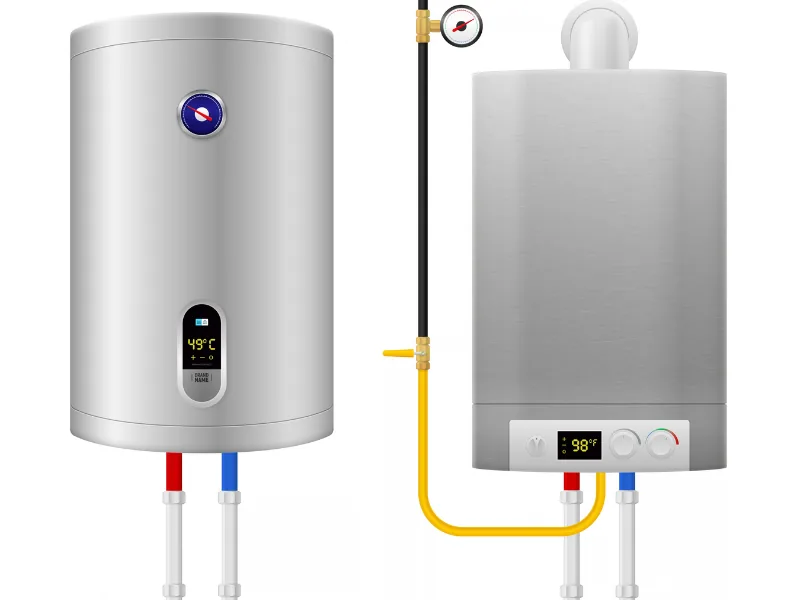
Side-By-Side Comparison
Where Loveland's Hard Water Changes The Math
This is the part generic tank-versus-tankless articles usually miss. Front Range water carries enough mineral content that maintenance frequency is a bigger factor here than in a soft-water region. A tankless unit's narrow heat exchanger scales up faster than a tank's larger reservoir, which means the real-world maintenance schedule for a tankless system in Loveland is more like every 8 to 10 months rather than the standard annual recommendation you'll see in most national guides. That's not a reason to avoid tankless, but it is a real cost and time commitment worth factoring in upfront.
Who Tankless Makes The Most Sense For
Households running multiple showers, a dishwasher, and laundry at the same time regularly are the clearest case for tankless, since a tank simply runs out of stored hot water under that kind of simultaneous demand. Homeowners planning to stay in the house long-term also get more value out of tankless's longer lifespan, provided the maintenance schedule is actually kept up.
Who A Standard Tank Still Makes Sense For
A single-person or two-person household with modest, staggered hot water use often gets a perfectly good result from a standard tank at meaningfully lower upfront cost. If you're not planning to stay in the home for the decade-plus timeframe where tankless's efficiency savings really add up, a tank replacement is often the more practical near-term choice.
What The Install Actually Involves
Switching from tank to tankless isn't always a simple swap. It can require upgraded gas line capacity, new venting, and sometimes electrical work depending on the unit, all of which factor into the upfront cost beyond just the appliance itself. A straightforward tank replacement, by contrast, is usually a same-day job in most cases. Either way, a proper installation includes sizing the unit correctly for your household rather than defaulting to whatever was there before.
Already Have A Tankless Unit That's Underperforming?
If you already have a tankless system and it's not living up to the endless-hot-water promise, that's more often a maintenance issue than a reason to switch back to tank. A flush and inspection resolves the large majority of tankless complaints we see, well before replacement is actually the right call.
Fuel Type Considerations
Both tank and tankless units come in gas and electric versions, and the choice interacts with the tank-versus-tankless decision in a real way. A gas tankless unit generally delivers higher flow rates than an electric tankless unit, which matters more for larger households with multiple simultaneous hot water draws. Electric tankless units are simpler to install where gas isn't already run to the location, but may require an electrical panel upgrade to supply enough amperage, which is worth factoring into the upfront cost comparison alongside the unit itself.
What A Realistic Payback Period Looks Like
Tankless units cost more upfront but use less energy over time, and the payback period depends heavily on how much hot water your household actually uses. A high-usage household can see the efficiency savings offset the higher upfront cost within several years. A lower-usage household stretches that payback period out much longer, sometimes past the point where either unit would need replacing anyway, which is worth being honest about rather than assuming tankless always pays for itself quickly.
Common Questions
Can I switch from tank to tankless without major renovation? Sometimes, but not always. If your existing gas line and venting can support a tankless unit's requirements, the swap is more straightforward. If not, expect additional work and cost for line upsizing or new venting.
Do tankless units run out of hot water like tank units do? Not in the same way. A tankless unit can run out of capacity if demand exceeds its maximum flow rate, for example multiple showers and a washing machine running at once on an undersized unit, but it won't run cold the way a tank does after its stored volume is used up.
Is a tankless unit harder to repair than a tank unit? Not inherently harder, but it does require a technician familiar with tankless-specific components like the flow sensor and heat exchanger, rather than the simpler thermostat and element setup on a tank unit.
A Third Option Worth Knowing About: Hybrid Heat Pump Units
Beyond standard tank and tankless, hybrid heat pump water heaters are a third category worth being aware of, using a heat pump to extract warmth from surrounding air rather than burning gas or using a resistance element directly. They tend to be the most energy-efficient option for households that use a lot of hot water, though they cost more upfront than a standard tank and need adequate surrounding air volume and temperature to work efficiently, which rules them out in some smaller mechanical rooms or unconditioned spaces.
How To Actually Decide
If you're still unsure after weighing all of this, the most useful exercise is to think through a typical busy morning in your household. Count how many showers, loads of laundry, and dishwasher cycles realistically overlap, and be honest about how often that actually happens versus how often it's a rare worst case. That single mental exercise settles the tank-versus-tankless question for most households faster than comparing spec sheets, since it gets straight to the one factor, simultaneous demand, that matters more than any other in this decision.
One More Factor: Resale Value
If you're planning to sell within the next several years, it's worth knowing that tankless units are often viewed as a desirable upgrade by buyers, particularly in a market where energy efficiency is a selling point. That said, a well-maintained standard tank with documented service history isn't a red flag either. Most buyers and inspectors are more concerned with whether a water heater of either type has been properly maintained than with which category it falls into.
Want help deciding which fits your home and household? Call Loveland Pro Plumbing at (970) 708-6013.